Below is a list of materials that we commonly work with
Metals
1008 Steel
This low-carbon steel is often used for its good formability and weldability. In seal applications, it might be chosen for its affordability and suitability for certain structural components or housings.
5052-H32 Aluminum
This aluminum alloy is known for its excellent corrosion resistance and formability. It’s lightweight, making it suitable for components where weight reduction is important without sacrificing mechanical properties.
6061-T6 Aluminum
Another aluminum alloy, 6061-T6 is known for its strength, good corrosion resistance, and weldability. It’s often chosen when higher strength and hardness are required compared to 5052 aluminum.
304 Stainless Steel
This stainless steel grade is widely used due to its excellent corrosion resistance, good formability, and durability. It’s suitable for seals exposed to moisture, chemicals, or other corrosive environments.
316 Stainless Steel
Known for its superior corrosion resistance compared to 304 stainless steel, 316 is often used in seals where exposure to harsh chemicals or saline environments is expected. It offers excellent performance in marine and industrial settings.
Hastelloy C-276
This is a super-alloy known for its exceptional corrosion resistance to a wide range of chemicals, including acids, chlorides, and other harsh environments. It’s chosen for seals in extremely corrosive applications where standard stainless steels may not suffice.
D2 Tool Steel
D2 tool steel is a high-carbon, high-chromium, air-hardening tool steel known for its excellent wear resistance and toughness. This is typically the material T3 uses for our tooling.
PTFE
Virgin
Pure PTFE without any fillers, offering good chemical resistance and low friction.
Good for chemicals, water, steam, gases, oils
Graphite Filled
Adds lubricity, thermal conductivity, and electrical conductivity. Used in applications requiring enhanced wear resistance and low friction.
Good for aggressive chemicals, moderate to high-pressure gases, oils.
Carbon Filled
Improves wear resistance and dimensional stability. Often used in dynamic sealing applications.
Good for hydraulic fluids, water, mild acids, hydrocarbons, gasoline, solvents.
Carbon / Graphite Filled
Combines properties of both carbon and graphite for improved wear resistance and conductivity.
Good for high-temp oils, aggressive chemicals, fuels, water.
Euro Graphite Filled
Graphite with enhanced properties specific to European standards or specifications.
Good for aggressive chemicals, high-pressure gases, hydraulic fluids, oils, solvents.
Ceramic Sphere / Euro Graphite Filled
Incorporates ceramic spheres for improved wear resistance and dimensional stability.
Good for aggressive chemicals, high-pressure gases, hydraulic fluids, oils, solvents.
Glass Filled
Enhances compressive strength, wear resistance, and dimensional stability. Used in applications where increased mechanical strength is needed.
Good for water, hydraulic fluids, oils, gasoline, refrigerants, mild acids.
Glass / Moly Filled
Combines glass with molybdenum disulfide for improved wear resistance and low friction.
Good for hydraulic fluids, oils, fuels, water, gases, moderate chemicals.
Glass / Cobalt Filled
Combines glass with cobalt for improved wear resistance and high-temperature stability.
Good for water, hydraulic fluids, oils, gasoline, refrigerants, mild acids and bases.
Carbon Fiber Filled
Increases strength, stiffness, and wear resistance. Suitable for high-performance applications.
Good for harsh chemicals, high-temperature oils, abrasive media, solvents, fuels.
Carbon Fiber / Titanium Ferrous Oxide (Modified)
Increases strength, stiffness, and wear resistance. Suitable for high-performance applications.
Good for harsh chemicals, high-temperature oils, abrasive media, solvents, fuels.
Polyimide Filled
Provides high temperature resistance and low outgassing properties, suitable for aerospace and electronic applications.
Good for aerospace fluids, high-temperature gases, oils, solvents, electronics cooling fluids.
Ekonol Filled
Provides high temperature stability and resistance to wear and chemicals.
Good for high-temperature oils, harsh chemicals, solvents, fuels, hydraulic fluids.
Mineral Filled
Typically used to modify mechanical properties such as hardness and wear resistance.
Good for water, hydraulic fluids, mild acids and bases, oils, solvents, refrigerants.

Gasket Materials
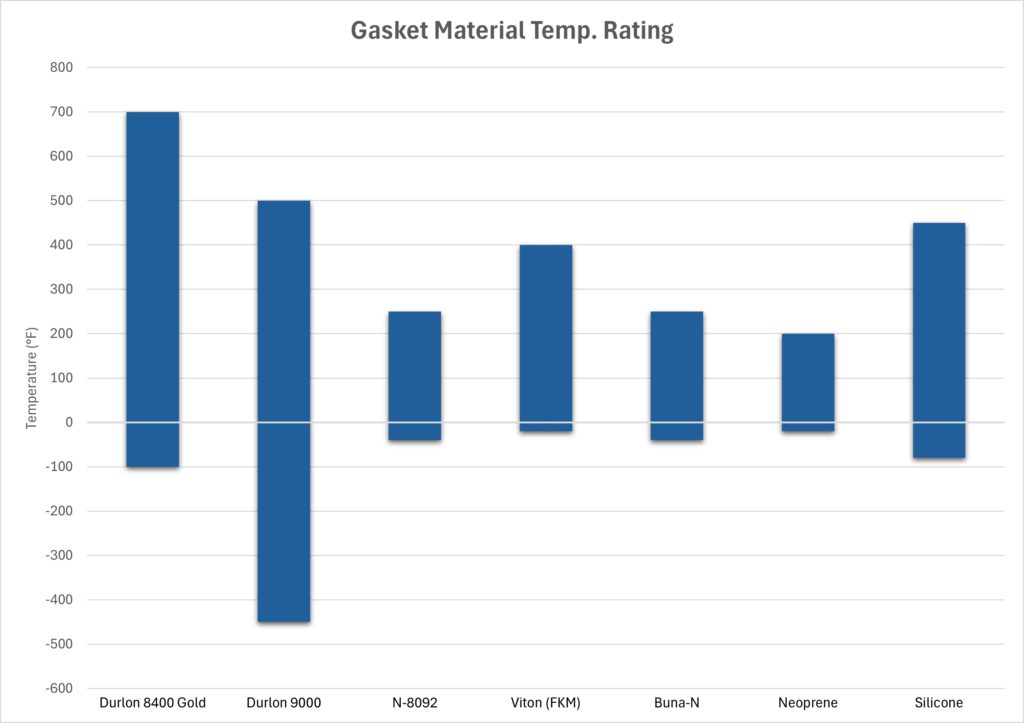
Durlon 8400 Gold
A high-performance compressed sheet gasket material that combines aramid and inorganic fibers with a high-quality rubber binder. It’s designed for use in a wide range of industrial applications, providing excellent seal-ability and chemical resistance. Also works well in applications involving water, oils and fuels.
Durlon 9000
A premium grade PTFE-based gasket material filled with glass microspheres. It offers exceptional chemical resistance and is suitable for a wide range of aggressive chemical applications, including those involving strong acids and caustics. Good for cryogenic applications.
N-8092
A cellulose fiber-based gasket material often used in automotive, marine, and industrial applications. It is designed for applications involving water, oil, and fuels, providing good sealing properties at a low cost.
Viton (FKM)
A high-performance fluoroelastomer known for its excellent resistance to high temperatures, chemicals, and oil. Viton is commonly used in automotive, aerospace, and industrial applications where high heat and aggressive chemicals are present.
Buna-N
Buna-Nitrile is a synthetic rubber material known for its excellent resistance to oils, fuels, and other petroleum-based products. Buna-N is widely used in automotive, aeronautical, and industrial applications where oil resistance is required.
Neoprene
A versatile synthetic rubber with good chemical stability and flexibility over a wide temperature range. Neoprene is used in a variety of applications, including automotive, industrial, and marine environments.
Silicone
A synthetic elastomer known for its excellent thermal stability, flexibility at low temperatures, and resistance to UV light, ozone, and weathering. Silicone is commonly used in food, medical, automotive, and industrial applications.
Metal Coating/Plating
Phosphate
Phosphate coating is a chemical treatment applied to seal casings, forming a protective layer that enhances corrosion resistance and improves surface adhesion for lubricants and seals. This coating provides a robust foundation for PTFE rotary lip seals, ensuring reliable performance in demanding environments, such as industrial machinery and automotive applications, by reducing wear and extending service life.
Zinc Dichromate
Zinc dichromate coating offers superior corrosion protection for seal casings, creating a durable, sacrificial barrier that shields against rust and environmental degradation. Ideal for harsh operating conditions, this coating ensures long-lasting performance and compatibility with PTFE rotary lip seals, making it a trusted choice for applications in marine, automotive, and heavy-duty industrial systems.
Anodize
Anodizing is an electrochemical process that forms a tough, corrosion-resistant oxide layer on seal casings, typically aluminum. This enhances the casing’s durability, wear resistance, and aesthetic finish while maintaining precise tolerances for PTFE rotary lip seal integration. Anodized casings are well-suited for high-performance applications in aerospace, automotive, and precision machinery, offering excellent protection in corrosive or high-temperature environments.
Electro Galvanizing
Electro galvanizing applies a uniform zinc coating to seal casings through an electroplating process, providing excellent corrosion resistance and a smooth, consistent surface. This coating enhances the longevity and reliability of PTFE rotary lip seals in applications exposed to moisture, chemicals, or abrasive conditions, such as pumps, compressors, and industrial equipment, ensuring optimal sealing performance.